




Vietnam itinerary planning requires more than selecting popular destinations and arranging transportation between them. For travel agents, creating a successful Vietnam tour means balancing travel distances, seasonal conditions, client expectations, and reliable local services.
From the historic streets of Hanoi and the limestone landscapes of Ha Long Bay to Hoi An’s cultural heritage and the waterways of the Mekong Delta, Vietnam offers remarkable diversity. However, combining these experiences into a well-paced journey can be challenging, particularly for agents managing arrangements from overseas.
Even small planning oversights can result in rushed sightseeing, unnecessary transfers, unsuitable activities, or service disruptions. Understanding these challenges early helps travel professionals develop itineraries that are both appealing to clients and realistic to operate.
In this guide, we explore five common mistakes travel agents should avoid when planning Vietnam tours, along with practical recommendations for creating smoother, more personalized journeys.
Why Vietnam Itinerary Planning Requires More Than a Good Route

Vietnam stretches across more than 1,600 kilometers from north to south, with distinct landscapes, climates, and travel experiences across its regions. While this diversity makes the country an attractive destination, it also introduces several considerations for itinerary design.
A journey combining Hanoi, Ha Long Bay, Hoi An, and Ho Chi Minh City may look straightforward on a map. In practice, it involves coordinating domestic flights, road transfers, accommodation schedules, and activities that may be affected by weather or local operating conditions.
Travel agents must also consider the different expectations of their clients. A couple celebrating an anniversary may prefer a relaxed journey with private cultural experiences, while a multigenerational family may prioritize shorter transfers, flexible schedules, and comfortable accommodations.
The challenge becomes even greater when arranging a multi-destination itinerary involving several suppliers. Hotels, guides, transportation providers, cruise operators, and experience hosts must work together to deliver a consistent journey.
Effective Vietnam itinerary planning therefore depends on five essential factors: realistic pacing, regional weather awareness, efficient logistics, client-focused design, and coordinated local services.
Overlooking any of these elements can affect both the traveler’s experience and the agent’s ability to deliver the promised program.
5 Common Vietnam Itinerary Planning Mistakes Travel Agents Should Avoid
1. Trying to Cover Too Many Destinations in One Trip

Vietnam offers an impressive variety of destinations, and clients often arrive with ambitious wish lists. Hanoi, Sapa, Ha Long Bay, Ninh Binh, Hue, Hoi An, and Ho Chi Minh City may all be on their radar.
The problem arises when agents attempt to include too many of these destinations within a limited timeframe.
For example, a 10-day Vietnam itinerary covering all seven destinations may appear comprehensive, but the number of transfers and hotel changes leaves little time for meaningful exploration. Instead of enjoying the country’s cultural and natural highlights, travelers may spend much of their vacation moving between locations.
This is particularly problematic for clients seeking a comfortable private journey, where flexibility and personal experiences are often more valuable than the number of places visited.
How travel agents can avoid this mistake
Begin by identifying the client’s priorities rather than building the itinerary around a checklist of famous attractions.
For a 10-day journey, consider focusing on selected destinations in Northern and Central Vietnam, such as Hanoi, Ninh Binh, Ha Long Bay, and Hoi An. This creates more opportunities for cultural encounters, scenic experiences, and comfortable travel days.
Travelers with 14 days or longer may have greater flexibility to combine the country’s three main regions.
When deciding whether to include an additional destination, consider the time required to reach it and whether the experience justifies the transfer.
The goal is not simply to reduce the number of stops. It is to ensure that every destination contributes meaningfully to the journey.
2. Overlooking Vietnam’s Regional Weather Differences
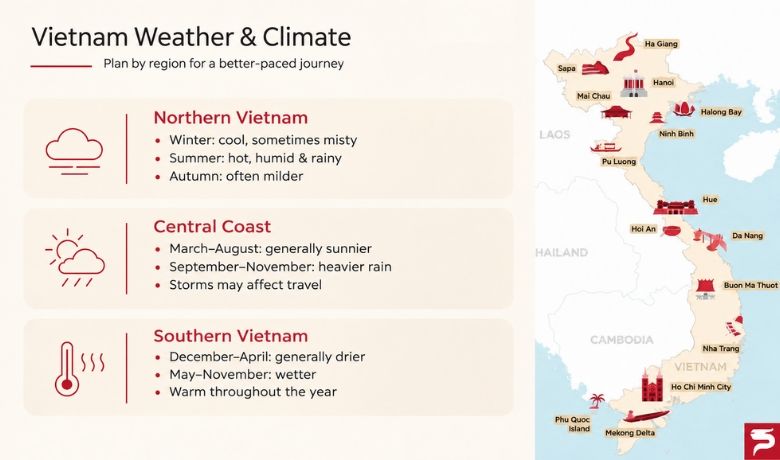
One of the most important considerations in Vietnam itinerary planning is understanding that weather conditions vary significantly between regions.
Northern Vietnam generally experiences cooler winters and hot, humid summers. Central Vietnam has its own seasonal rainfall patterns, with the later months of the year bringing a greater risk of heavy rain and flooding in destinations such as Hue and Hoi An. Southern Vietnam typically experiences distinct wet and dry seasons.
These differences mean that a travel period suitable for one region may be less favorable for another.
For instance, October can offer pleasant conditions for exploring parts of Northern Vietnam, while Central Vietnam may experience prolonged rainfall. Similarly, travelers seeking a beach vacation in December may find Phu Quoc a more suitable option to investigate than certain beaches along the central coast.
Weather considerations also extend beyond comfort. Heavy rainfall, storms, and rough seas can affect cruises, outdoor activities, road transfers, and other travel arrangements.
How travel agents can avoid this mistake
Evaluate the climate of each destination individually before finalizing an itinerary.
Rather than applying a single recommendation for the best time to visit Vietnam, consider the client’s preferred experiences and how seasonal conditions may affect them.
For example, if beach relaxation is a major priority, choose the coastal destination based on the travel dates rather than simply adding the nearest beach to the route.
For itineraries during wetter periods, build flexibility into outdoor activities and discuss realistic expectations with clients before departure.
Working with a local destination specialist can also help agents understand seasonal operating considerations and identify appropriate alternatives when conditions change.
3. Underestimating Travel Times and Transfer Logistics
Travel distances are another common source of planning errors.
Vietnam’s transport network makes it possible to combine several destinations within one trip, but actual door-to-door travel times can be longer than expected.
A domestic flight may take just over an hour, yet the full journey also involves traveling to the airport, completing check-in procedures, collecting luggage, and transferring to the next hotel.
Similarly, a Ha Long Bay cruise involves road transportation from Hanoi, arrival at the embarkation point, and a fixed boarding schedule. These arrangements must be coordinated carefully with the surrounding itinerary.
When agents underestimate these details, travel days can become unnecessarily demanding. Clients may arrive too late for planned activities or have insufficient time to rest before the next excursion.
How travel agents can avoid this mistake
Plan transfers using realistic door-to-door estimates rather than flight durations or distances alone.
Several practical considerations can improve itinerary feasibility:
- Allow sufficient time for airport procedures, baggage collection, and ground transfers.
- Avoid scheduling major sightseeing activities immediately after long journeys.
- Confirm cruise embarkation and disembarkation schedules before arranging connecting services.
- Include appropriate rest stops during longer road transfers.
- Allow additional flexibility around weather-dependent activities and important flight connections.
Travel agents should also consider the client’s age group, mobility requirements, and tolerance for frequent hotel changes.
For a family traveling with young children or older relatives, a slightly longer stay in fewer destinations may provide a more enjoyable experience than a tightly scheduled multi-city itinerary.
Careful logistics planning may be less visible than the attractions featured in a proposal, but it has a direct impact on the comfort and overall quality of the journey.
4. Designing the Itinerary Before Understanding the Client

A technically well-organized itinerary does not necessarily mean it is the right itinerary for the traveler.
One common mistake is selecting destinations, accommodations, and activities before developing a clear understanding of the client’s expectations.
A couple planning a honeymoon, a family traveling across generations, and a group of friends interested in outdoor adventures may all want to visit Vietnam. However, their preferred experiences, daily schedules, and accommodation requirements can be very different.
Even travelers within the same demographic may have contrasting interests. Some prefer immersive cultural activities, while others prioritize relaxation, scenic landscapes, or culinary experiences.
Without sufficient client information, agents risk recommending programs that are attractive on paper but poorly suited to the people taking the trip.
How travel agents can avoid this mistake
Establish a clear traveler profile before requesting an itinerary proposal.
Important details to clarify include:
- Travel purpose: Is the trip a honeymoon, anniversary, family vacation, or cultural exploration?
- Previous experience: Is this the client’s first visit to Vietnam or a return journey?
- Travel preferences: Do they prefer cultural encounters, outdoor activities, relaxation, or a combination?
- Travel pace: Would they enjoy full sightseeing days or prefer more time at leisure?
- Accommodation expectations: What level of comfort, hotel style, and room arrangements are preferred?
- Practical requirements: Are there any dietary preferences, accessibility considerations, or mobility limitations?
- Travel framework: What are the dates, duration, and approximate budget?
These answers provide the foundation for a genuinely personalized itinerary.
For example, a multigenerational family might benefit from shorter excursions, fewer hotel changes, and experiences suitable for different ages. Meanwhile, a couple interested in local culture could enjoy private heritage walks, artisan workshops, and carefully selected dining experiences.
Understanding the client from the beginning also makes communication with local partners more efficient, reducing the need for repeated revisions and helping ensure that proposed services align with expectations.
5. Treating Local Suppliers as Separate Bookings Rather Than One Coordinated Journey

A multi-destination Vietnam tour typically involves several service providers, including hotels, transportation companies, local guides, cruise operators, restaurants, and activity hosts.
Even when each supplier provides a reliable individual service, the overall journey can suffer if arrangements are not properly coordinated.
For example, a change in flight arrival time may affect airport pickup, hotel check-in, and scheduled sightseeing. A delayed transfer could also create difficulties when the next activity operates on a fixed departure schedule.
These challenges become more complicated when different suppliers are responsible for separate parts of the itinerary without a clear coordination process.
For overseas travel agents, managing such arrangements remotely can require significant time and attention, particularly when unexpected changes occur.
How travel agents can avoid this mistake
Approach the itinerary as one connected travel experience rather than a collection of individual bookings.
A reliable local Destination Management Company (DMC) can help agents review route feasibility, coordinate suppliers, communicate special requirements, and manage operational adjustments.
Before confirming the program, agents should clarify service responsibilities, inclusions, pickup arrangements, and procedures for handling disruptions.
Local expertise is particularly valuable for customized journeys involving multiple regions, private cultural experiences, or transportation arrangements that require close coordination.
By working with a destination partner who understands the full itinerary, travel agents can reduce administrative complexity and maintain greater consistency throughout the client’s journey.
How Asia Pioneer DMC Supports Better Vietnam Itinerary Planning

Successful Vietnam itinerary planning requires a balance between destination expertise, operational feasibility, and a clear understanding of the traveler’s expectations.
For overseas travel agents and tour operators, having a dependable local partner can make this process more efficient while opening opportunities to develop distinctive travel experiences.
At Asia Pioneer DMC, we support international travel professionals with Vietnam itinerary planning, creating private, tailor-made journeys around their clients’ interests, travel dates, preferred pace, and accommodation requirements.
Rather than relying on a fixed itinerary for every inquiry, our approach focuses on understanding the individual requirements behind each trip and developing a program that connects destinations, experiences, and local services thoughtfully.
From evaluating suitable routes and recommending cultural experiences to coordinating accommodation, transportation, and guiding services, our destination knowledge supports agents throughout the planning process.
For travel professionals, this means having a local partner who can help translate client expectations into a practical, well-coordinated journey.
Whether you are designing a first-time visit, a family vacation, or a specialized travel program, the right local support can make Vietnam itinerary planning more efficient, helping you avoid common mistakes and tailor the journey to your clients’ needs.
Planning a Vietnam journey for your clients? Share your requirements with Asia Pioneer DMC to explore how we can help you develop a tailor-made itinerary that meets their expectations.

FAQs About Vietnam Itinerary Planning
How many days should travel agents recommend for a Vietnam tour?
The ideal duration depends on the destinations and the client’s preferred travel pace. Around 10 days can work well for a focused itinerary covering selected regions, while 14–16 days generally allows greater flexibility for combining Northern, Central, and Southern Vietnam.
What is the biggest mistake in Vietnam itinerary planning?
One of the most significant mistakes is trying to include too many destinations without accounting for realistic travel times. Frequent transfers and hotel changes can reduce the time available for meaningful experiences and make the journey unnecessarily tiring.
When should travel agents start planning Vietnam tours?
Agents should begin planning once the client’s approximate travel dates, trip duration, budget, and travel preferences are known. Earlier planning is particularly valuable during peak travel periods, major holidays, and for itineraries requiring specific accommodations or experiences.
Why should travel agents work with a local Vietnam DMC?
A local DMC can help travel agents assess itinerary feasibility, coordinate suppliers, recommend suitable experiences, and manage operational details across multiple destinations. This support is especially valuable for customized private tours involving complex logistics or specialized travel requirements.